Automation Kits
Five runnable n8n workflows for operations teams: ticket triage, lead scoring, review response, customer onboarding, and an internal standard operating procedure (SOP) bot. Each runs end to end on a local model and routes only the high-stakes cases to a person. Portfolio proof for the Human-in-the-Loop Automation service — not a separate product SKU.
- Role
- Sole builder: design, prompts, n8n workflows, human-in-the-loop (HIL) gates
- Domain
- Operations automation (hospitality-leaning)
- Surface
- 5 kits on one shared, runnable 5-node spine
- Stack
- n8n · local Ollama (phi4:14b) · JSON mode · rule-based gate
- Principle
- AI drafts. A deterministic gate escalates the risky cases
- Status
- Runnable + self-tested end to end on sample runs · production channels pending
The Operational Problem
Operations teams run on inbound volume: support tickets, sales leads, public reviews, new-account onboarding, staff policy questions. Most of it is routine and could be handled in seconds. A small slice is genuinely high-stakes: a refund dispute, a safety incident, an enterprise contract, a one-star review naming a guest.
The naive fix, letting AI answer everything, is unsafe, because a confident wrong answer lands exactly on that high-stakes slice. The opposite, making a person read everything, spends the scarce resource on cases that never needed it. These kits are built around that tension: absorb the routine volume automatically, and guarantee the high-stakes cases reach a human.
The Product Principle
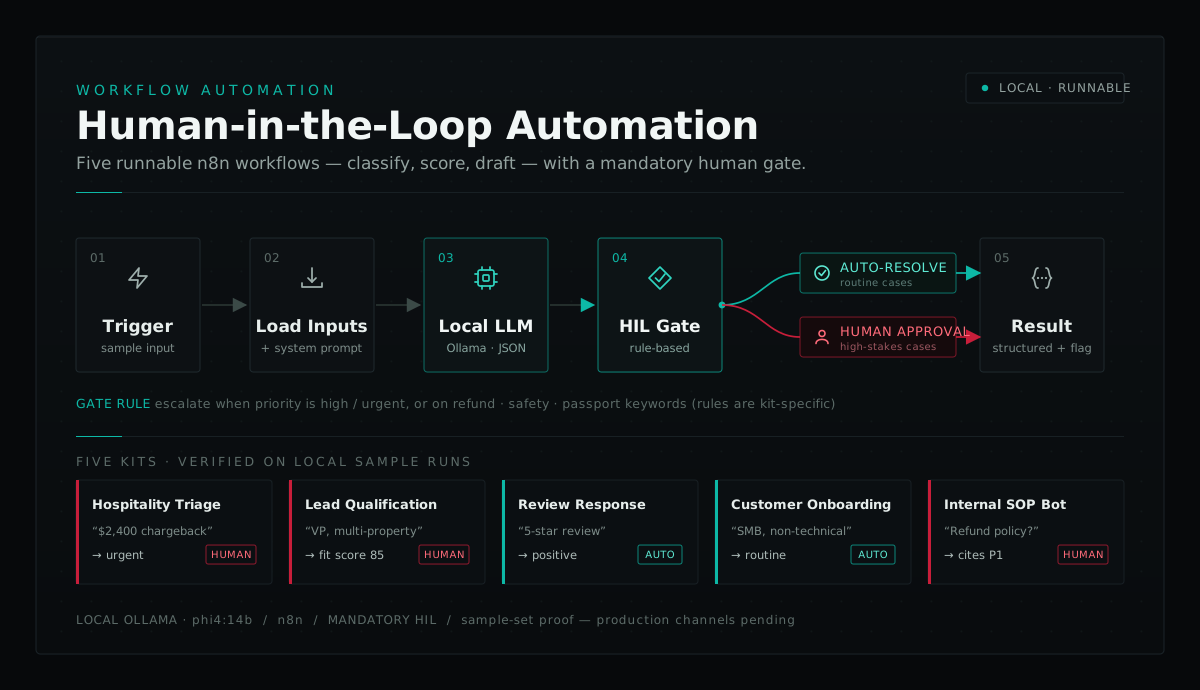
One rule holds across all five: AI drafts, a human approves anything risky, never the reverse. And the escalation decision is not left to the model's discretion alone. Each workflow runs a two-layer gate. First the model returns its own requires_human_approval flag inside strict JSON. Then deterministic code (a fixed rule in plain code, the same input always gives the same result) re-checks the case against kit-specific rules and can force escalation regardless of what the model said.
The model is allowed to be cautious. It is never the only thing standing between an automated action and a guest, a dollar, or a safety event.
How One Workflow Runs
Every kit is the same runnable spine of five n8n nodes, no cloud API keys, executable on a laptop:
- Trigger: a sample case enters the workflow.
- Load Inputs: the case is paired with the kit's system prompt.
- Local AI model (a large language model, or LLM): Ollama (phi4:14b) returns strict JSON (json mode, temperature 0.2).
- Parse + HIL Gate: the JSON is parsed, then the kit-specific rule decides auto-resolve vs. human approval.
- Result: a structured object plus the human-approval flag.
The same five kits also ship a design-exact production graph that swaps the local model for real channels and models, covered below.
The Five Kits
Five kits, one spine. Each classifies, scores, or drafts in its domain and carries its own escalation rule. Every example below is a verified sample run from the local build.
Hospitality Ticket Triage
Human- Decides
- category, priority (low → urgent), department, guest-facing draft reply
- Escalates when
- priority is high/urgent, or the text mentions refund, chargeback, passport, safety, injury, or legal
- Verified run
- “$2,400 chargeback”→priority: urgentHuman
Lead Qualification + Scoring
Human- Decides
- how well a lead fits your ideal customer (ICP), 0 to 100, tier A/B/C, intent, next-best action, reply
- Escalates when
- score ≥ 80, tier A, enterprise/security/legal terms, or a borderline lead with hot intent
- Verified run
- “VP, multi-property, budget approved”→fit score 85Human
Review Response Agent
Auto- Decides
- sentiment, category, severity, brand-voice public response
- Escalates when
- negative sentiment or high severity
- Verified run
- “5-star review”→positiveAuto
Customer Onboarding Engine
Auto- Decides
- segment, personalization plan, first steps, risk flags, welcome
- Escalates when
- enterprise/high-value, single sign-on (SSO), security/legal, money-touching, or missing consent
- Verified run
- “SMB, non-technical”→routineAuto
Internal Ops SOP Bot
Human- Decides
- answer, cited SOP references, confidence, reply grounded in approved source documents (retrieval-augmented generation, or RAG)
- Escalates when
- low confidence, or the question touches a spill, safety, HR, refund, or waiver
- Verified run
- “Refund policy?”→cites P1Human
From Prototype to Production
Alongside each runnable kit is a design-exact production scaffold: an importable n8n graph that is not yet run with live data. They share a common shape:
- Multi-channel intake: webhook, email, schedule, or Telegram.
- Normalize: dedup, canonical schema, and consent / lawful-basis checks.
- Cheap classifier → premium drafter: cost-tiered models, with citation-enforced retrieval (RAG) where there is a knowledge base.
- Force-HIL validation: the deterministic gate, in code.
- Mandatory approval: a send-and-wait step in Slack or email, with an approve / redraft / escalate router. Execution only fires after approval.
- Audit + recovery: an immutable log with cost tracking, a dedicated error sub-workflow, and feedback capture for continuous improvement.
Productionizing a kit means swapping the local-Ollama node for its real channels and model, adding credentials, and feeding sanitized data.
- The five runnable kits execute end to end on local Ollama with no cloud API keys, verified on built-in sample inputs (2026-06-02, gate retest 2026-06-19).
- The production graphs are design-exact and importable, but have not yet been run with real channels or data.
- No client metrics or ROI claims: this is sample-set proof of the classify/score/draft plus human-gate logic.
- Sample inputs are synthetic and the embedded SOP policies are illustrative.