- Role
- Product Strategy, Workflow Design & Prototype Build
- Stage
- Live sandbox · synthetic data
- Stack
- Next.js, TypeScript, Zustand, pdf-lib, JSZip
- Scope
- Synthetic ACATS-style transfer review · read-only
01
Challenge
ACATS review teams need to move quickly when a transfer looks incomplete or suspicious while the deadline is already running. The workbench explores how that moment can be made clearer without turning the software into an approval engine or a fraud model.
02
Build Decisions
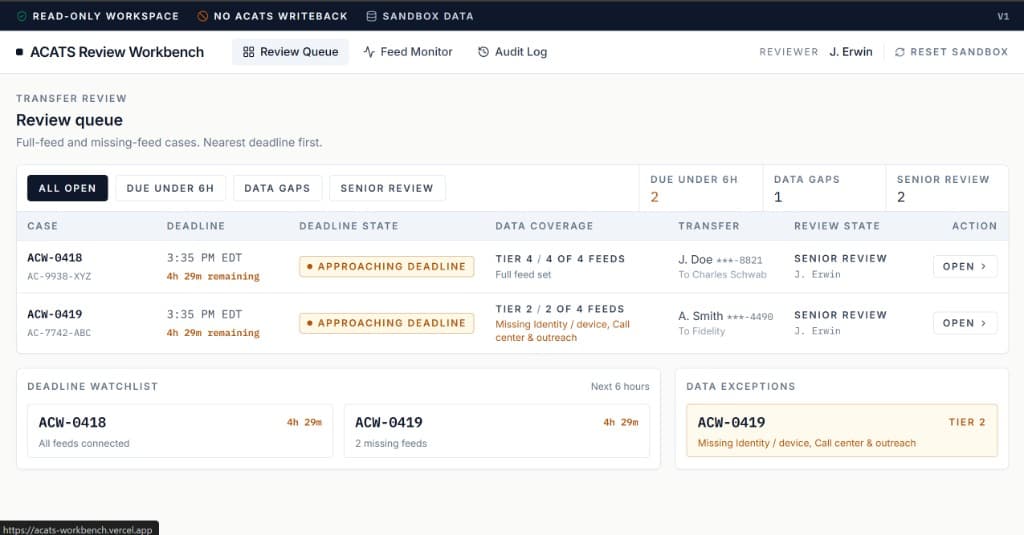
- Presenting deadline state, feed coverage, and case context in one reviewer workspace.
- Withholding computed deadline confidence when required data feeds are stale, missing, or disconnected.
- Freezing pinned evidence, pressure notes, supervisor rationale, and data scope into an exportable decision package.
03
Sandbox Walkthrough
Views from the sandbox build, captured against synthetic fixtures. The header strip on every screen restates the operating boundaries: read-only workspace, no ACATS writeback, sandbox data. Click any frame to enlarge.
04
Outcome Evidence
- Live Vercel deployment with five screens: queue, case workspace, package preview, feed monitor, and audit log.
- Client-side decision package generation with a supervisor-attested PDF and structured JSON manifest.
- Synthetic fixtures that demonstrate full-feed and missing-feed cases without loading customer, account, or transfer data.
05
Reliability and Trust Notes
- Reviewer-owned decisions: the system supports judgment; it does not replace it.
- Traceable context: every recommendation surface should make its inputs and reviewer actions easy to inspect later.
- Minimal public detail: the portfolio version demonstrates product thinking while keeping sensitive mechanics out of view.
Scope Boundaries
- Sandbox prototype on synthetic case data only — no customer, account, or transfer data is loaded.
- Read-only review surface: does not transmit, approve, reject, block, hold, or modify transfer instructions.
- Not connected to ACATS, DTCC, NSCC, or any clearing platform; not deployed at any bank, broker-dealer, or customer.
- Decision authority remains with authorized reviewers; software organizes context and preserves the audit trail only.
- Public artifact demonstrates product judgment without exposing sensitive mechanics.